Your intro sucks. Fix the first 30 seconds before anything else.
If your retention drops below 70% in the first 30 seconds, nothing you do at the middle or end of the video matters — the audience is already gone. The 2025 average YouTube video retains just 23.7% of its viewers. Here’s the exact intro template that holds 75%+ retention.
If your retention drops below 70% in the first 30 seconds, nothing you do at the middle or end of the video matters — the audience is already gone. The 2025 average YouTube video retains just 23.7% of its viewers, and only 1 in 6 videos surpass the 50% retention mark.[1] Long sizzle reels, “hey what’s up guys” intros, and shop-walkthrough montages don’t survive that math. The fix: pay off your packaging promise inside the first 30 seconds, and keep going.
The single biggest reason your video underperforms.
You can have a great hook idea, a solid story, a clean edit, decent thumbnails — and still get cooked by the algorithm if your first 30 seconds suck.
Here’s the data: over 33% of viewers drop off in the first 30 seconds when the intro isn’t engaging.[1] More than 55% drop off inside the first minute. And YouTube’s own Creator Insider channel confirmed in 2025 that creators should establish value within seven seconds.
Across both of my channels, our videos average 75–80% retention in the first 30 seconds. That’s not a flex. That’s the floor we built deliberately, after we accepted that everything before second 31 is the only fight that matters in 2026.
Here’s the truth most creators won’t admit: if people click and jump off in the first 30 seconds, the problem is probably not the video. You have a packaging-promise problem.
You’re losing them at the door. And you’re trying to fix it by polishing the kitchen. (For the bigger picture on why polish doesn’t fix structural problems, see why more subscribers won’t fix your channel — the same logic applies.)
What you’re probably doing in your intro right now.
Pull up your last 10 videos. Look at the first 30 seconds. I’d bet money you’re doing one of these:
- Standing there talking — “Hey what’s up guys, today we’re gonna…”
- Sizzle reel intro — your logo, animation, the song you’ve used for three years, 10–15 seconds of you walking through your shop or B-roll of past projects
- Backstory dump — explaining why you started this channel, why you love this craft, your dad, your hometown, your why
- Project setup — talking about the tools, the wood, the materials, the plan, before the viewer has any reason to care
All four had their moment. In 2018, you could blab for two minutes and get away with it because everyone was doing it. Audiences had patience because they had to. Creators had patience because their competitors weren’t punishing them for it.
That window is closed.
Why nobody’s patient anymore.
You’ve probably read the stat that human attention spans dropped to “8 seconds, less than a goldfish.” That stat is fabricated — Microsoft Canada included it in a 2015 report citing a firm called Statistic Brain, which couldn’t produce a credible source when journalists checked. There is no peer-reviewed research supporting an 8-second average human attention span.
What we’re actually seeing comes from the growing popularity of short-form content in general. Viewers get a dopamine fix from TikTok and Instagram, and those viewer behaviors carry over into everything they watch.
Your viewers haven’t suddenly become goldfish. What’s actually changed is the competition for the first 30 seconds — and three things shifted simultaneously:
- Shorts trained the entire YouTube audience to expect a payoff of some kind in 3 seconds
- The recommendation engine learned to punish slow openings hard — improving average retention by 10 percentage points correlates with a 25%+ increase in impressions from YouTube’s algorithm[1]
- A massive flood of creators learned to package fast, so your competitors are now hooking better than you are
Your audience didn’t get worse. Your competition got better.
The fix: pay off your packaging promise. That’s it.
Your packaging promise is whatever your title and thumbnail told the viewer they were going to see.
If your thumbnail shows a tool with a price tag — talk about that tool inside the first 15 seconds.
If your title says “I built X for $50” — show the build or name the cost in the first 15 seconds.
If your hook is “5 mistakes I made building this” — the first mistake should land before the 30-second mark.
You don’t owe the viewer your full juice in the first 30 seconds. You owe them the proof that the click was honest. That’s all. Once they trust the click, they’ll give you 60–90 seconds to build context. Without that trust, you have nothing.
Here’s the rule we use across our content team: whatever’s in the thumbnail is what gets paid off in the first :30, in one way or another. Not later. Not after the intro. Inside the first :30.
What “paying off the promise” actually looks like.
A recent video from JMR Rebuilders, one of our members, titled I Bought a $900 Diesel. They don’t go too long in the intro. They have a great hook, then they literally pay off “I bought a $900 diesel” by verbalizing it, showing it, and getting some work in action — super fast.
What do they get in return? 79% of viewers are still watching at the 0:30 mark — and YouTube Studio flags that as “above typical.”
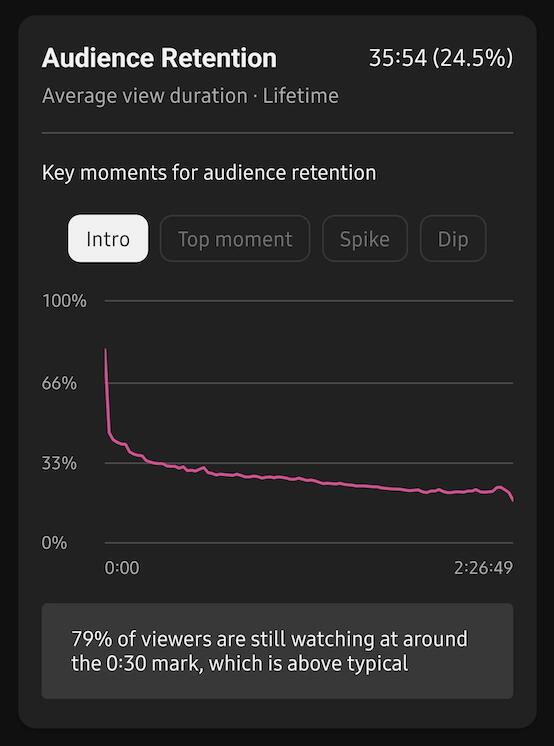
The video is 2 hours 26 minutes long. Average view duration is 35 minutes 54 seconds — 24.5% of the runtime. For a two-and-a-half-hour video, that’s structural retention, and it starts at second 30. The graph tells the whole story: a fast initial dip as the casual clickers leave, then a near-flat plateau for the rest of the video. That’s what a paid-off packaging promise looks like in YouTube Studio.
That’s not luck. That’s structural.
The intro template that works in 2026.
Here’s the only sequence I want you to use for the next 30 days:
- Visually pay off the thumbnail within the first 15 seconds — the same object, frame, or comparison from the thumbnail needs to be on screen. If you can’t show it visually, you have to attack it audibly.
- Verbally pay off the title within the first 15 seconds — name the thing you promised to deliver.
- Tease the stakes or the question — what’s at risk, what’s the real answer, why does it matter, in one sentence.
- Cut, action, momentum — inside 30 seconds, you should already be in the body of the video. No transitions to a sizzle reel. No song drop. No logo animation. Cut to the work.
That’s it. Four beats. Under 30 seconds.
If you’re below 70% retention at second 30 right now, this is the only thing I want you to focus on for the next month. Don’t redesign your set. Don’t change your voiceover style. Don’t start new series. Fix the intro. Pay off the promise. Cut everything else.
How to audit your own intros tonight.
Open YouTube Studio. Pull up your last 10 videos. For each one, look at:
- Retention at 0:15
- Retention at 0:30
- Average view duration
Industry benchmark: keeping 50–70% of viewers still watching at the 30-second mark is considered solid for videos longer than five minutes.[2] JMR Rebuilders hit 79% at 0:30. Our channels hold 75–80%. If you’re below 50%, you have a packaging-promise problem to fix before anything else.
Then watch your own intros back. Be honest. In the first 5 seconds, is the visual on screen the same thing your viewer was promised in the thumbnail? In the first 15 seconds, did you say the title back to them in some form? If either answer is no, you’ve found your problem.
Then go fix it on the next video. Not the past 100. Just the next one.
Britton joined the Boardroom in early 2026. After tightening his intros and packaging-promise discipline, his channel’s monthly views and revenue both stepped up dramatically. His own description: “More long form views = way more money.” Britton doubled his total business gross in a single month — February to March — and the intro discipline was a primary lever.
FAQ
How short does the intro need to be?
Get into it as fast as possible. Ideally under 20 seconds, definitely under 30. Most viewers decide to stay or leave in the first 30 seconds[3] — the longer your intro, the more your retention curve flattens before the algorithm has a chance to expand distribution.
What about creators who get away with long intros?
A few do — but they have so much trust built up with the audience that the audience tolerates the lag. You and I don’t have that yet. Earn it on the back of clean intros first. Industry benchmarks show only 1 in 6 videos surpass the 50% retention mark — none of them get there with bloated intros.[1]
Do I need to remove my intro music or logo entirely?
Yes. For the next 30 days, kill it. You can reintroduce a 2–3 second branded element later once your retention is healthy.
What if my thumbnail and title are the actual problem?
Then your first 30 seconds can’t save it. Packaging-promise discipline starts at the thumbnail. If your packaging is dishonest, your hook can’t be either, and the whole video underperforms.
How fast should I expect retention to improve?
You could literally see it on the next video. Inside 3–5 videos with disciplined intros, you’ll see 5–15 points of improvement on first-30s retention. Improving average retention by 10 percentage points correlates with a 25%+ increase in algorithm-driven impressions.[1]
- 2025 YouTube Audience Retention Benchmark Report · Retention Rabbit, 2025
- YouTube Audience Retention: Complete Guide · Social Rails
- YouTube Audience Retention · Teleprompter.com
Fix the intro. Then fix the business.
Intro retention is one slice of the Audience Engine pillar of the A.R.C. Method. Inside the Free $1M Creator A.R.C. Training, I walk through the full system — ideation, packaging, hook structure, retention math, and how to make every video carry weight inside a real business.